Building Context-Aware Solutions
When operational data remains disconnected, whether inside one platform or across several systems, organizations miss the insights that emerge from relationships, history, time, and location. This "missing knowledge" problem grows at scale, leading to missed opportunities and inefficient decisions. The composite events and patterns that drive intelligent operations remain invisible when occupancy data cannot connect to energy consumption, when weather patterns stay isolated from supply chain logistics, or when customer behavior exists separately from operational capacity.
This data fragmentation prevents organizations from achieving the holistic view with high granularity that modern operations demand. Consider a building management scenario: a temperature sensor knows when a room gets hot, but it doesn't know about the meeting scheduled there. A booking system knows when rooms are reserved, but it can't see occupancy patterns. An HVAC system responds to temperature changes, but it operates blind to actual usage. Each system works in isolation, holding pieces of a puzzle that could transform operations if connected.
The insights that matter most, the patterns that emerge when occupancy, temperature, and scheduling data combine, remain invisible because the data lives in separate worlds, creating blind spots that cost organizations efficiency, responsiveness, and competitive advantage.
Garnet Framework eliminates these blind spots by connecting data from any source into a unified knowledge graph. The architecture consists of three components working together:
Context Producers take data from any accessible data source, transform it into NGSI-LD compliant entities, and push them to the knowledge graph. You build dedicated producers for each data source, with each producer implementing the appropriate interface to extract data from its specific source - whether that involves fetching data through APIs, pulling from databases, or exposing endpoints to receive incoming data. Each producer converts its source's proprietary format into standardized NGSI-LD entities. The key value lies in bringing data from any source into this unified, standardized knowledge graph where it becomes accessible to any consumer.
Garnet Framework serves as the central component and single source of truth, providing a contextual layer that manages real-time context and temporal data through the Context Broker, while the built-in data lake preserves historical context. This dual approach gives consumers the flexibility to extract insights based on their specific needs - whether accessing current state, temporal patterns, or historical analysis. By decoupling Context Producers from Context Consumers, Garnet accelerates application development velocity - you can begin with a focused solution and incrementally add new data sources and consumers as requirements evolve, reusing existing infrastructure and patterns. Built-in discovery capabilities enable new consumers, including autonomous agents, to quickly understand what entity types and attributes are available in the knowledge graph, allowing them to assess the current state without unnecessary data fetching. This enables consistent system connections and provides AI systems, including agentic solutions, with immediate access to rich contextual insights across all temporal dimensions. The result is a unified operational view where all your data connects and makes sense together.
Context Consumers access this unified view to extract insights, detect patterns, and trigger actions. These range from traditional applications like dashboards displaying real-time operational conditions and analytics platforms processing historical trends, to intelligent systems such as autonomous agents making decisions based on contextual awareness, notification systems triggering alerts when specific conditions are met, and ML inference engines analyzing patterns to predict outcomes. Context Consumers can also act as Context Producers, creating intelligent feedback loops - for example, an autonomous AI agent performing an action based on current context can store the results back into the knowledge graph, or a system performing ML inference can contribute its predictions either as new contextual entities or as attributes on existing entities, such as adding a predicted maintenance state to a machine entity or weather forecasts to location entities, enabling other consumers to leverage these insights.
This transformation enables unprecedented operational intelligence: entities that were isolated in separate systems can now connect and be understood as part of larger operational patterns. An autonomous agent managing building efficiency can access not just current temperature readings, but understand how they correlate with occupancy trends, scheduled events, and historical patterns, enabling intelligent decisions based on complete contextual awareness rather than fragmented data points.
Solution Architecture
The following diagram illustrates how Context Producers, Garnet Framework, and Context Consumers work together to create unified operational intelligence. It provides multiple examples of systems using different technologies and various context consumers, demonstrating the flexibility and technology-agnostic nature of the architecture:
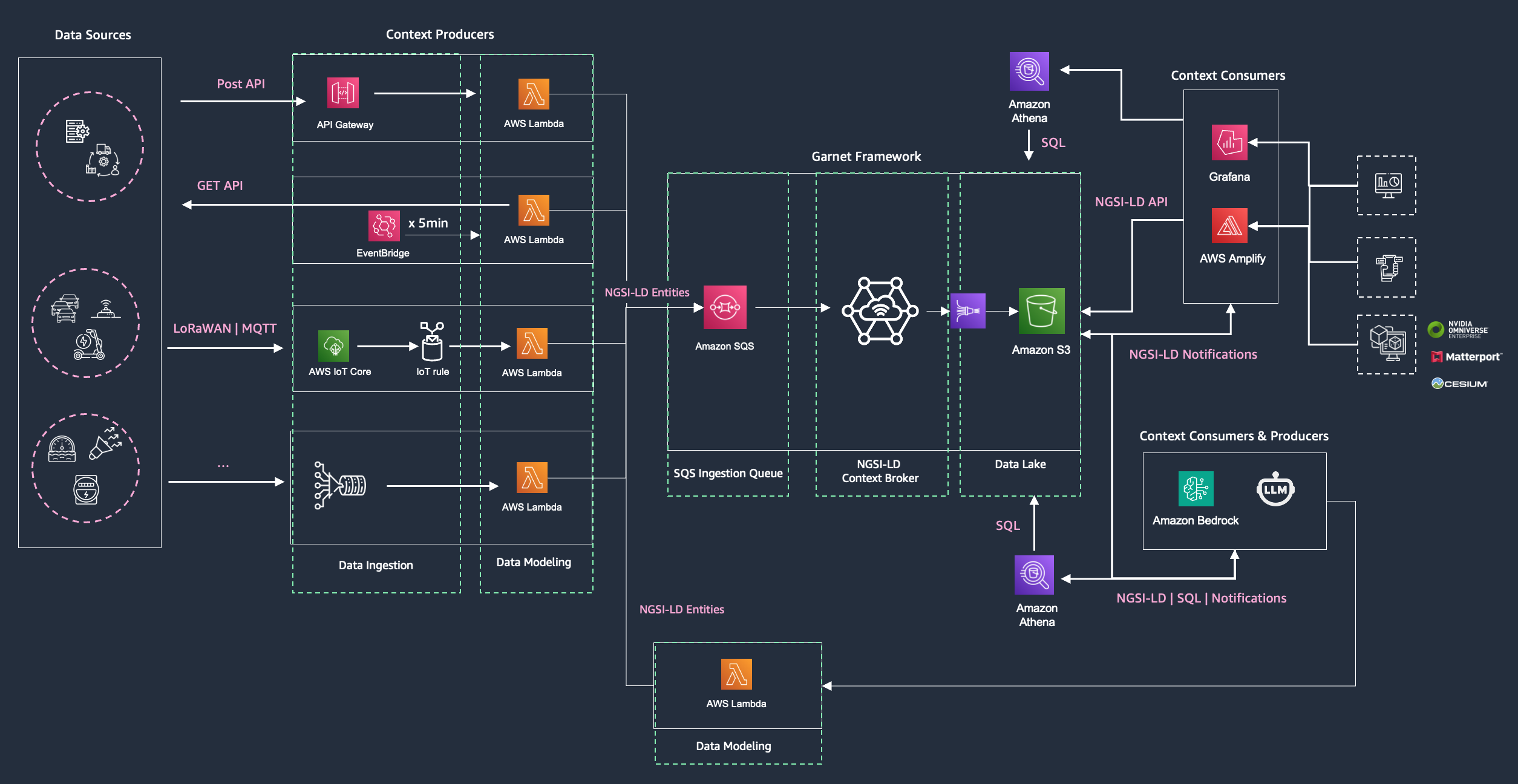
Garnet's architecture separates data production from consumption, enabling independent development and evolution of each component. Context Producers transform raw data from any source into standardized NGSI-LD entities and push them to Garnet's knowledge graph. Context Consumers then query or subscribe to this unified information layer, gaining access to contextual insights without needing to understand the underlying data sources or transformation processes.
For example, consider data flowing from LoRaWAN sensors through AWS IoT Core for LoRaWAN. The LoRa Network Server (LNS) sends messages to an IoT Rule, which forwards them to a Lambda function that transforms the data into NGSI-LD entities and sends them to Garnet's SQS ingestion queue. Once in the knowledge graph, this sensor data becomes available through multiple consumption paths:
- Real-time Access: Applications query the NGSI-LD API for current sensor readings and device status
- Historical Analysis: Data analysts use Amazon Athena to query the data lake for trend analysis and pattern recognition
- Event-driven Actions: Subscriptions notify systems such as autonomous agents when sensor values exceed thresholds, enabling immediate responses
Contextual Intelligence: Beyond these access patterns, the sensor data connects with other entities like room schedules and occupancy patterns, revealing insights invisible to isolated systems.
This complete data flow demonstrates how a single data source can serve multiple consumption patterns simultaneously, from real-time operational dashboards to predictive analytics and autonomous system responses.
You can build each independently as the information model is standardized and known in advance. This means different teams and organizations can build Context Producers and Context Consumers and seamlessly connect them through Garnet to build a solution.
Solution Examples
Context-aware solutions built with Garnet Framework apply across diverse operational domains. The architectural principles remain consistent: Context Producers extract data from various sources and transform it into NGSI-LD entities, while Context Consumers access the unified knowledge graph to extract insights and trigger actions.
In customer relationship management, Context Producers aggregate call logs, agent interactions, customer touchpoints, and service history into a unified view that enables personalized support and predictive service delivery. Manufacturing operations connect equipment sensors, production schedules, and maintenance records to optimize efficiency and predict failures. Urban management systems integrate traffic patterns, environmental conditions, and citizen services to improve city operations. Supply chain solutions correlate shipment tracking, environmental conditions, and inventory levels to ensure quality and optimize logistics. Building management systems combine occupancy data, environmental sensors, and scheduling information to optimize energy usage and space utilization.
Garnet's geospatial capabilities enable location-aware solutions with straightforward geofencing. Fleet systems trigger alerts when vehicles enter zones, emergency response identifies resources within incident areas, and delivery systems notify stakeholders when trucks reach neighborhoods.
Temporal and historical capabilities analyze current conditions against historical patterns to identify anomalies and predict trends. Systems recognize patterns like weather-related delivery delays or equipment performance cycles to enable proactive adjustments.
Subscription mechanisms create event-driven architectures through interval-based updates for dashboards and condition-based triggers for immediate actions. When thresholds are exceeded, systems automatically notify teams, adjust controls, and coordinate responses across organizational boundaries.
This event-driven approach proves particularly valuable for autonomous agents, which perform optimally when provided with rich context and clear action triggers. An agent managing energy distribution can subscribe to weather forecasts, demand patterns, and equipment status to make informed decisions about resource allocation. When the agent takes action, it can store the results back into the knowledge graph, creating a stateful system where each decision builds upon previous actions and outcomes. This feedback loop enables increasingly sophisticated autonomous behavior as the system learns from its operational history.
The knowledge graph approach reveals patterns invisible to isolated systems. When environmental conditions correlate with operational schedules, when customer interactions connect to service capacity, when equipment performance relates to production demands, the contextual connections enable intelligent responses that consider the complete operational picture rather than fragmented information.
For additional real-world examples and case studies, explore our blog posts where we share real customer examples.
Next Steps
Now that you understand how Context Producers, Garnet Framework, and Context Consumers work together to create context-aware solutions, the following sections will provide detailed guidance on implementing each component:
The Context Producers section will cover how to connect your data sources and transform information into NGSI-LD entities, including implementation patterns, data transformation techniques, and best practices for building robust data ingestion components.
The Context Consumers section will explain how to build applications that leverage the unified knowledge graph, exploring different access patterns, application categories, and implementation approaches for consuming contextual intelligence.
You can also follow the tutorials for complete end-to-end implementation examples that demonstrate complex systems and solution patterns.