Overview
Garnet Framework is an open-source framework for building living digital twins of operations and context-aware solutions through dynamic knowledge graphs and the ETSI NGSI-LD open standard.
A living digital twin is a connected operational model that continuously reflects the entities involved, their properties and relationships, what is happening now, what changed over time, and where it is happening. Applications, domain-specific digital twins, analytics, and AI systems can use that same live, traceable context.
Garnet Framework provides real-time context management, temporal data capabilities, geospatial queries, subscription-based notifications, and automated data lake integration. It is built on the NGSI-LD open standard and uses open-source NGSI-LD Context Broker technology. It can be deployed in an AWS account using the AWS Cloud Development Kit (CDK).
In an architecture, this living digital twin acts as a context layer: the shared, continuously updated operational model between systems that produce context and the applications, analytics, digital twins, or AI systems that consume it.
What is a Dynamic Knowledge Graph?
A dynamic knowledge graph is a semantic knowledge representation model that captures and organizes information in the form of interconnected entities and their relationships, while allowing for continuous updates and changes to the underlying data in near real-time. Unlike static knowledge graphs that represent fixed relationships, a dynamic knowledge graph evolves as the real-world systems it represents change, enabling you to maintain an accurate and current view of your operations.
Knowledge graphs focus on the semantic meaning and context of connections between data, going beyond simple data storage. While graph databases excel at storing and querying connected data, a knowledge graph is more about understanding and representing the meaning of these connections. A knowledge graph can be implemented using various storage technologies - not necessarily a graph database - as its value lies in how it models and represents relationships and context, not in how the data is physically stored.
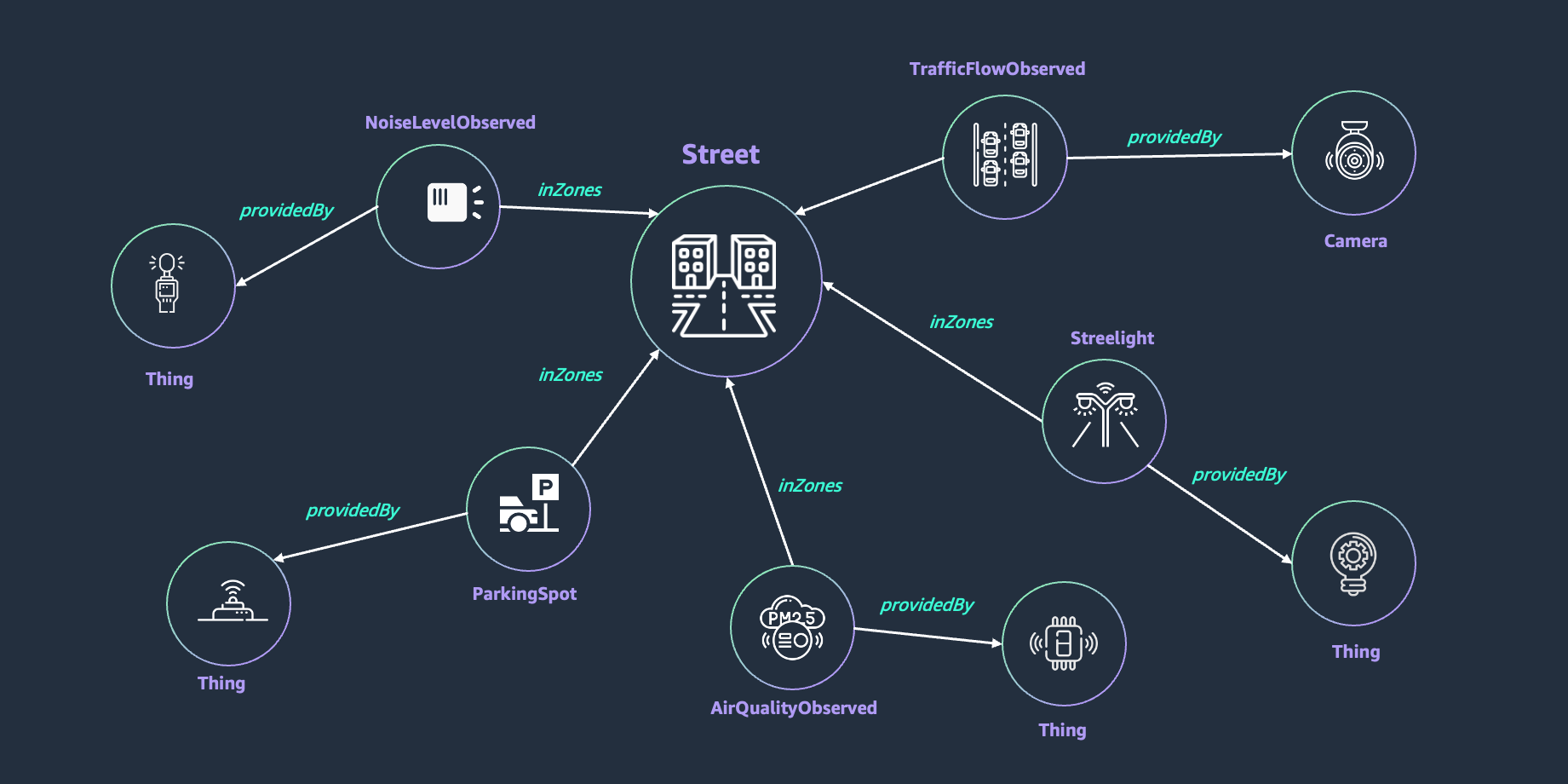
Garnet Framework enables you to create living digital twins of your complex systems and processes that continuously reflect real-world changes, supporting real-time monitoring, analysis, and decision-making.
Core Features
Garnet Framework leverages NGSI-LD to enable modeling and managing context information as an evolving knowledge graph, where entities represent real-world objects and concepts that can be described with properties and interconnected through relationships.
Through its temporal capabilities, applications can store and query historical states of entities at specific timestamps or during time intervals, including statistical aggregations of temporal data.
The framework supports location-based context through standardized geospatial formats, enabling spatial queries and geofencing capabilities.
A subscription mechanism allows applications to monitor specific conditions and receive immediate notifications when relevant changes occur in the context information.
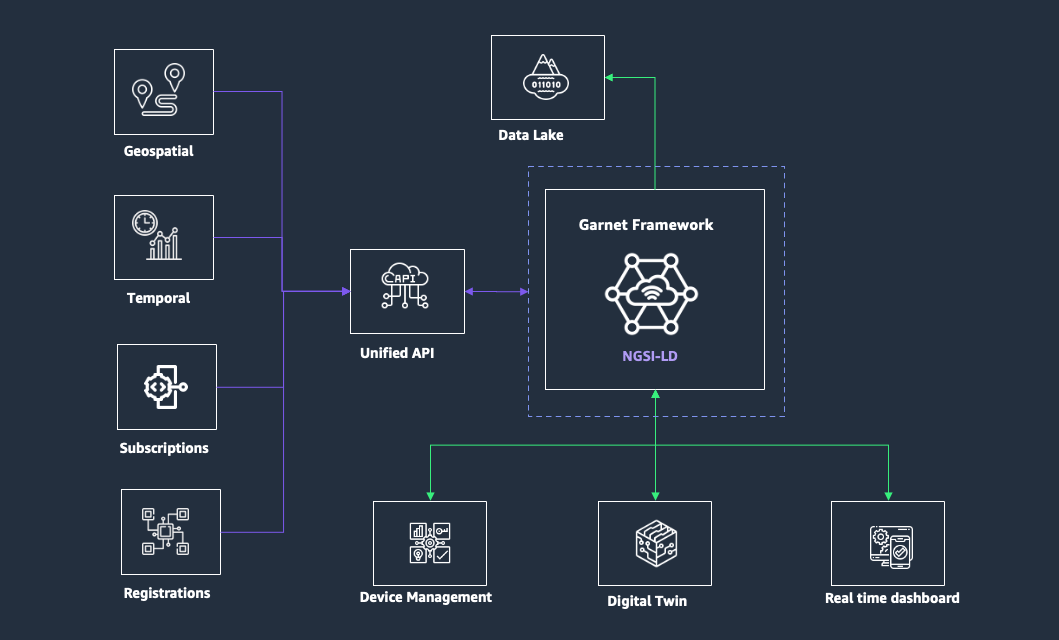
Additionally, Garnet Framework provides off-the-shelf integration with Amazon S3 through Amazon Kinesis Data Firehose, automatically creating a data lake storing all NGSI-LD structured data for immediate analysis using tools like Amazon Athena without requiring additional ETL processes.
Architecture Overview
Garnet Framework combines the power of NGSI-LD Context Broker technology with AWS serverless services to create a scalable, cost-effective platform for building dynamic knowledge graphs and digital twins.
At its core, Garnet Framework uses a customized version of the open source NEC Scorpio NGSI-LD Context Broker implementation that we've specifically adapted for optimal AWS deployment. Our customized implementation, available through the Amazon ECR Public Gallery, manages the dynamic knowledge graph while leveraging AWS native services for improved reliability and operational efficiency.
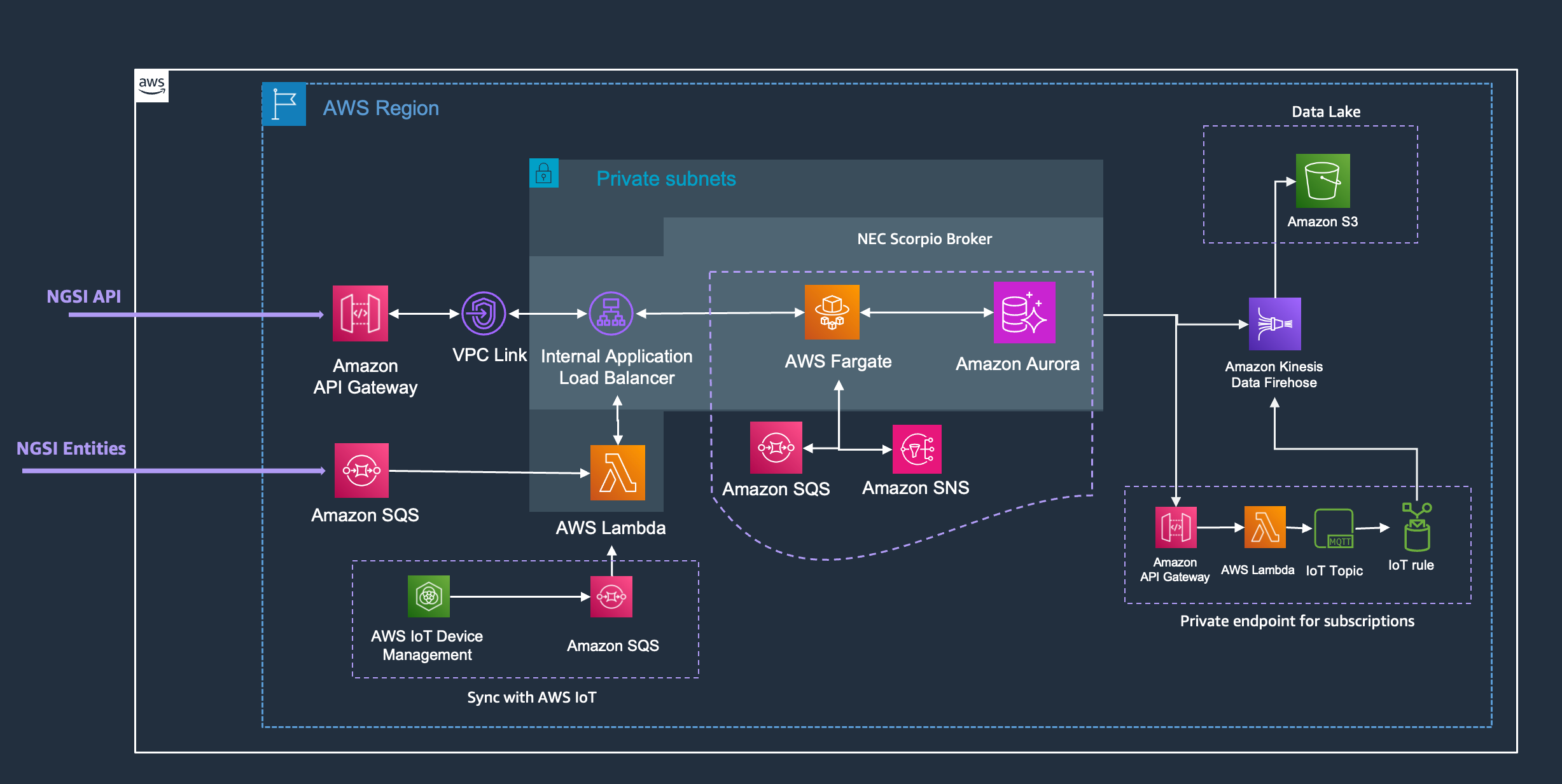
The framework provides several key capabilities:
- Unified API Access: A single unified endpoint through Amazon API Gateway HTTP API that you can customize with your own access control mechanisms and security requirements
- Efficient Data Ingestion: A managed SQS queue for batch ingestion of NGSI-LD entities, making it simple to connect with AWS services like Lambda functions
- AWS IoT Integration: Automatic synchronization of AWS IoT Core device management information, including connectivity status and group memberships
- Data Lake Analytics: Automatic storage of all context information in a data lake, with built-in integration with Amazon Athena for SQL-based querying and analysis of your historical context data
This serverless architecture allows you to focus on building smart applications while Garnet handles the complexity of managing context information and data relationships efficiently and cost-effectively.
Garnet Framework is continuously evolving, with plans to provide additional capabilities to enrich context management through integrations with other AWS services, AI tools, and industry protocols. Our goal is to make it even easier for you to build sophisticated, context-aware applications that can leverage the full power of AWS's ecosystem.
What You Can Build with Garnet?
In smart city environments, Garnet enables urban management systems that integrate data from traffic sensors, parking facilities, and public transport to optimize mobility. Environmental monitoring platforms can correlate air quality, noise levels, and weather data to improve citizen well-being, while waste management solutions can adjust collection routes based on actual fill levels.
For industrial operations, Garnet supports digital twins that provide visibility into manufacturing processes. These systems can monitor equipment performance, anticipate maintenance needs, and optimize production schedules by understanding the connections between different operational elements. Supply chain solutions can track goods and materials through their entire journey, maintaining context about conditions, locations, and handling at each stage.
In smart buildings, Garnet enables integrated management systems that connect HVAC operations, lighting controls, occupancy patterns, and environmental conditions. This comprehensive view allows for automation and optimization strategies that enhance both energy efficiency and occupant comfort.
Connected services benefit from Garnet's ability to maintain context across interactions and channels. Customer experience platforms can understand the full history of each interaction, while healthcare systems can coordinate care by maintaining a complete view of patient journeys, provider interactions, and resource utilization.
Garnet Framework enables AI applications by providing the essential contextual foundation these systems need. Through its ability to maintain a structured, real-time view of operational context, Garnet supports everything from contextual AI systems that understand and respond to complex situations, to predictive models leveraging historical patterns, to agentic AI solutions coordinating operations autonomously.
For example, in facility management, AI systems can access real-time building context to optimize operations and predict maintenance needs. In retail environments, AI applications can leverage current inventory, customer patterns, and store conditions to enhance decision-making and customer experience. By providing structured access to operational context and real-time updates about relevant changes, Garnet helps enable AI systems that can operate with deep awareness of their environment.
Get started now building smart solutions by deploying Garnet to your AWS account.